What is psoriasis?
Psoriasis is a long-term, immune-mediated inflammatory condition that mainly affects the skin and joints. An overactive immune response speeds up skin cell production, so cells build up into raised, scaly patches called plaques. In Malay it is also called psoriasis, and it is sometimes described as penyakit kulit bersisik (scaly skin disease).
Malaysia’s second-edition Clinical Practice Guidelines (CPG) on psoriasis, published in 2024, describe it as a genetically determined, systemic inflammatory condition rather than a skin problem alone. Psoriasis is not contagious, and it is not caused by poor hygiene.
Psoriasis usually follows a pattern of flares and calmer periods. There is currently no cure, but effective treatment can clear or substantially improve the skin and quality of life.
How common is psoriasis in Malaysia?
The Malaysian CPG estimates that psoriasis affects about 0.34% of people in Malaysia. Prevalence is higher among Malaysian Indians (0.54%) than among Malays (0.38%) and Chinese (0.29%).
Psoriasis can start at any age, including childhood. In the Malaysian Psoriasis Registry, the average age at onset in adults was about 34 years, and 24.7% of patients had a family history of psoriasis.
What causes psoriasis and what triggers flares?
Psoriasis develops from a combination of inherited genes and immune system changes. Immune signalling, particularly through the IL-23/Th17 pathway, drives inflammation and rapid skin cell turnover. Having a parent with psoriasis increases the likelihood of developing it.
Factors that can trigger psoriasis or make it worse include:
- Infections, especially streptococcal throat infections
- Skin injury, such as cuts, scratches or sunburn, where new plaques can appear (the Koebner phenomenon)
- Stress and depression
- Smoking and heavy alcohol use
- Obesity and weight gain
- Certain medicines, including lithium, some blood pressure medicines, antimalarials and some anti-inflammatory painkillers
- Stopping oral corticosteroids, which can provoke a flare
- Air pollution
If you think a prescribed medicine is a trigger, speak to your doctor before stopping it.
What are the types of psoriasis?
The Malaysian CPG describes five main types, and more than one can appear in the same person.
| Type | What it looks like | Key points |
|---|---|---|
| Plaque psoriasis (psoriasis vulgaris) | Raised, well-defined plaques with silvery scale on the scalp, elbows, knees and lower back | The commonest form, seen in 80–90% of patients |
| Guttate psoriasis | Many small, drop-shaped spots on the trunk and limbs | Often follows a throat infection in children and young adults |
| Inverse (flexural) psoriasis | Smooth, shiny red patches with little scale in skin folds | Can be mistaken for a fungal infection |
| Pustular psoriasis | Pus spots that are not infected, on the palms and soles or widespread | The widespread form needs urgent care |
| Erythrodermic psoriasis | Red, inflamed skin over most of the body | Uncommon but serious; needs urgent care |
Psoriasis affects the nails in 40–50% of patients, causing pits, discolouration, crumbling or lifting of the nail. On brown skin, plaques may look darker or purple rather than red, which can delay diagnosis. Psoriasis can resemble eczema and fungal rashes; read eczema vs psoriasis for the main differences, or see our pages on eczema and skin infections.
Is psoriasis only a skin condition?
No. Psoriasis is linked with inflammation elsewhere in the body, so good care looks beyond the skin.
- Psoriatic arthritis affects about 20% of people with psoriasis, according to the Malaysian CPG. Warning signs include joint pain or swelling, a swollen “sausage” finger or toe, heel pain, inflammatory back pain and prolonged morning stiffness. The CPG advises checking for these at least once a year.
- Heart and metabolic health. Psoriasis is associated with a higher risk of heart attack, stroke, high blood pressure, diabetes, raised cholesterol and fatty liver. In the Malaysian Psoriasis Registry, obesity was recorded in 62.9% of adult patients and high blood pressure in 28.5%.
- Emotional wellbeing. Psoriasis is linked with higher rates of depression and anxiety. The World Health Organization highlights the stigma, isolation and reduced quality of life that many people experience.
- Other conditions, such as inflammatory bowel disease and uveitis (eye inflammation), are also more common.
The Malaysian CPG recommends that everyone with psoriasis is screened for cardiometabolic and psychiatric conditions.
How is psoriasis diagnosed?
Psoriasis is usually diagnosed from its appearance and your history. A skin biopsy is occasionally needed when the rash does not look typical.
Before treatment starts, the Malaysian CPG recommends assessing both severity and quality of life. Severity can be measured by Body Surface Area (an adult palm is about 1% of the body), the Psoriasis Area and Severity Index (PASI) or a Physician’s Global Assessment. The Dermatology Life Quality Index measures the impact on daily life.
How is psoriasis treated in Malaysia?
Treatment is individualised according to severity, the areas affected, joint symptoms, other health conditions and pregnancy plans. Many people use a combination of treatments over time.
Topical treatments
For mild psoriasis, creams, ointments, gels and scalp preparations are usually the first step:
- Moisturisers, used regularly to soften scale and support the skin barrier
- Topical corticosteroids, the first-line topical treatment; stronger ones are used short-term and avoided on the face, genitals and skin folds
- Topical vitamin D analogues, alone or combined with a corticosteroid
- Coal tar and salicylic acid preparations, which help lift thick scale
- Topical calcineurin inhibitors for the face and skin folds
Phototherapy
Narrowband ultraviolet B (NBUVB) phototherapy is recommended for moderate to severe psoriasis, usually 2 to 3 sessions a week at a treatment centre. It is carefully dosed and monitored, and is not the same as sunbathing.
Systemic and biologic treatments
For moderate to severe psoriasis, a dermatologist may recommend:
- Conventional systemic medicines, which need regular blood tests
- Biologic therapies, injectable medicines that target specific parts of the immune system, usually for people whose psoriasis has not responded to, or who cannot use, phototherapy and conventional systemic medicines
- Oral small-molecule therapies
Before systemic or biologic treatment, you will usually be screened for infections such as hepatitis and tuberculosis, and your vaccinations will be reviewed.
Important safety points:
- Never stop systemic or biologic treatment without advice from your dermatologist.
- Some oral psoriasis medicines can harm an unborn baby. Discuss contraception and pregnancy plans before starting treatment.
- Oral steroid tablets and injections are generally avoided for psoriasis, because stopping them can trigger a severe flare.
The Malaysian CPG finds insufficient evidence to support complementary and alternative medicines for psoriasis.
Living with psoriasis in Malaysia
- Sun and heat. Sunlight helps some people’s psoriasis, but sunburn can trigger new patches. Use shade, clothing and sunscreen rather than relying on sun exposure.
- Sweat and skin folds. Heat, sweat and friction can aggravate inverse psoriasis in the groin, armpits and under the breasts, where yeast infections can also develop. Keep folds dry and wear loose cotton clothing.
- Fasting month. If you take systemic or biologic treatment, discuss how to time it around sahur and iftar with your dermatologist before Ramadan, rather than stopping.
- Healthy habits. Stopping smoking, limiting alcohol, keeping to a healthy weight and staying active support both skin and heart health.
- Scalp psoriasis. It is often mistaken for stubborn dandruff (kelemumur). Thick, well-defined scale beyond the hairline is a reason to see a doctor.
- Unregulated creams. Products promising to clear psoriasis permanently may contain undeclared steroids, and stopping them can cause a rebound flare. Check products with the National Pharmaceutical Regulatory Agency (NPRA).
- Getting care in Selangor. Phototherapy needs frequent visits, so travel time matters. Government hospital dermatology clinics usually need a referral letter, while private specialist hospitals generally accept direct appointments.
When should you see a dermatologist for psoriasis?
The Malaysian CPG suggests dermatology referral when:
- The diagnosis is uncertain
- Psoriasis is extensive, for example covering more than 10% of the body surface
- Psoriasis cannot be controlled with topical treatment within 12 weeks
- It affects the scalp, face, nails, hands, feet or genitals and has a major functional or cosmetic impact
- It has a major effect on physical, psychological or social wellbeing
See a doctor, who may involve a rheumatologist, if you develop joint pain, swelling or stiffness.
Seek urgent medical care if your skin becomes red and inflamed over most of the body, or if widespread pus spots appear, especially with fever, chills or feeling unwell. These may be signs of erythrodermic or generalised pustular psoriasis, which the Malaysian CPG says should be referred urgently.
Seeing Dr Kartini for psoriasis
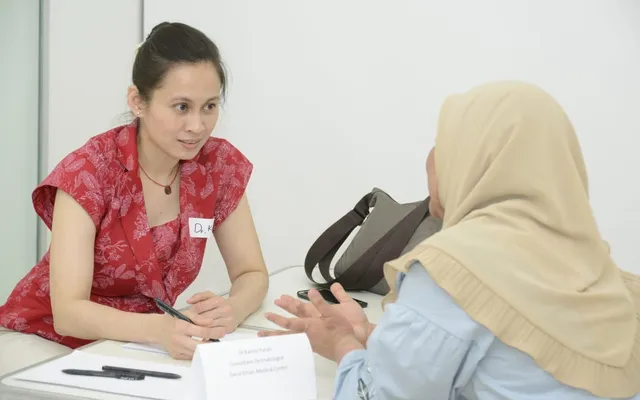
Dr Kartini Farah Rahim is a Consultant Dermatologist registered on Malaysia’s National Specialist Register in dermatology and internal medicine. She practises at Avisena Specialist Hospital and Avisena Women’s & Children’s Specialist Hospital in Shah Alam, Selangor, and consults in English and Bahasa Malaysia. Psoriasis is one of her areas of clinical focus.
A psoriasis consultation usually involves:
- History: skin symptoms, possible triggers, joint symptoms, family history, other health conditions, medicines and previous treatments
- Examination: of the skin, scalp and nails, to assess the type and extent of psoriasis
- Diagnosis: confirming psoriasis and its severity, and looking for related conditions such as psoriatic arthritis
- Management plan: an individualised plan, from topical care to phototherapy, systemic or biologic options where appropriate, with safety monitoring
- Follow-up: regular reviews to check response, side effects and overall health
You can read more about Dr Kartini, view her credentials or book an appointment.