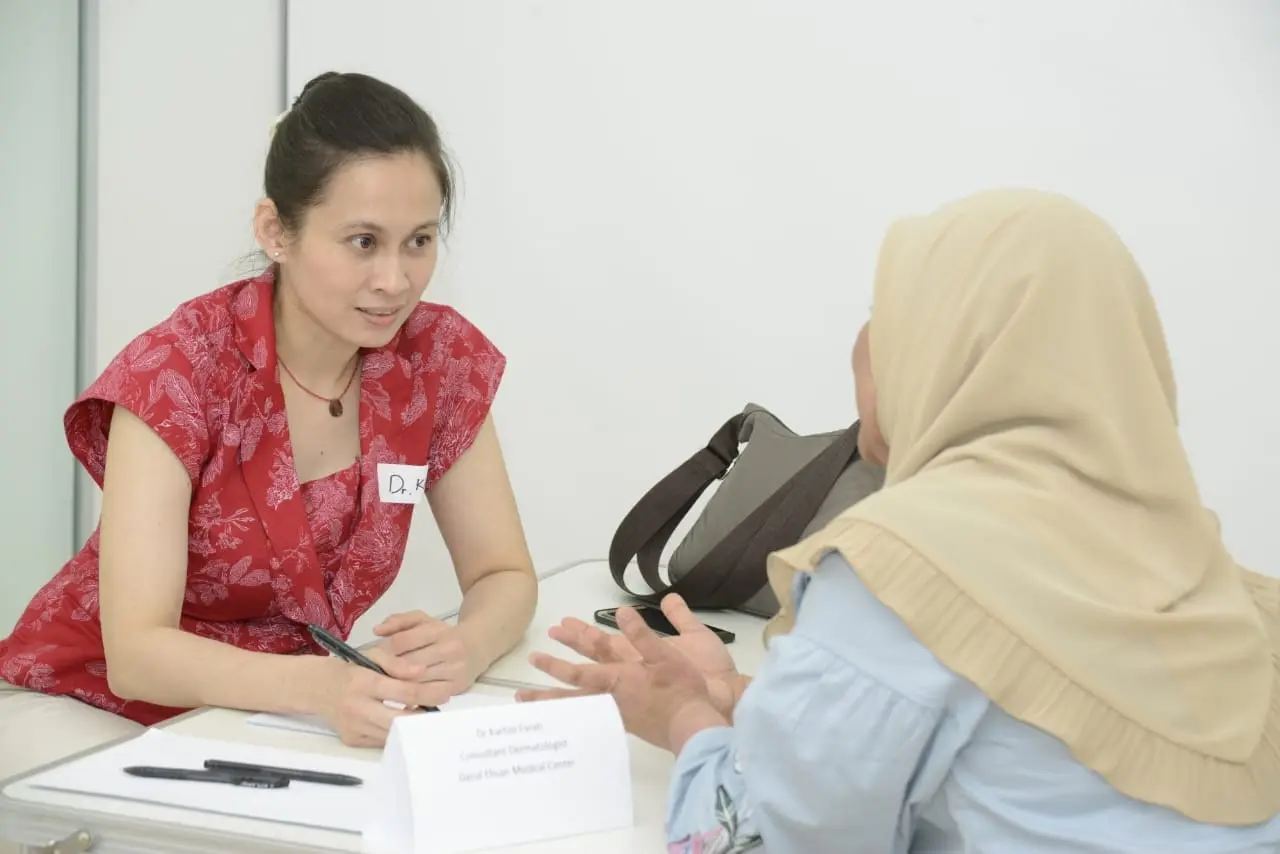
Choosing a dermatologist in Malaysia comes down to two things: verification and fit. First, confirm that the doctor is registered with the Malaysian Medical Council (MMC) and listed under dermatology on the National Specialist Register (NSR). Both registers can be searched online in a few minutes. Then consider whether the doctor’s experience, location, language and approach suit your skin condition and your life. A clear diagnosis, an honest explanation and a realistic plan matter far more than a polished clinic or a large social media following.
This guide explains what the different titles mean, how to check them, and what to look out for before you book.
What is the difference between a dermatologist, a GP and an aesthetic practitioner?
In everyday conversation, “skin doctor”, “skin specialist” and “pakar kulit” are used loosely. They can describe people with very different training.
| Who | Registration and training | Typical focus | When they fit |
|---|---|---|---|
| Dermatologist (pakar kulit) | Registered doctor with postgraduate qualifications and structured dermatology training, listed under dermatology on the National Specialist Register | Diagnosing and managing diseases of the skin, hair and nails, including long-term and complex conditions | Persistent, severe, recurrent or uncertain skin problems |
| General practitioner (GP) | Registered doctor providing first-contact care for all areas of health | Common rashes, infections and minor skin problems, with referral when needed | A new or mild skin problem, or when you need a referral letter |
| Aesthetic practitioner | May be a registered doctor with additional training in cosmetic procedures; check the MMC register | Appearance-related treatments | Cosmetic concerns, once medical skin disease has been addressed |
| Beauty therapist or salon “skin specialist” | Not a registered medical practitioner | Facials and beauty treatments | Grooming and relaxation, not medical diagnosis |
A GP is often the right first step for a new, mild problem, and will refer you on when a condition is not settling. A beauty therapist, however skilled at facials, is not trained or registered to diagnose skin disease or prescribe medicine. If someone describes themselves as a skin specialist, it is perfectly reasonable to ask exactly what they are registered as.
What does “consultant dermatologist” mean in Malaysia?
A dermatologist is a doctor who has completed specialist training in dermatology and is registered as a specialist in that field. “Consultant” is a seniority title used by hospitals and in the public service, generally for specialists with further experience after specialist registration.
For patients, the practical point is that a title on a website or business card is not what you should rely on. What matters is registration. The Medical Act 1971, as amended in 2012, and the Medical Regulations 2017 came into force on 1 July 2017. Under these rules, a doctor whose name is not on the Specialist Register must not practise as a specialist in that specialty.
So any consultant dermatologist in Malaysia should be findable on the NSR under dermatology. “Pakar kulit” simply means skin specialist in Bahasa Malaysia, and the same check applies.
How do I check a dermatologist on the MMC register and the National Specialist Register?
Both checks can be done on your phone before you book.
- Search the MMC Medical Register. The MMC’s public search tool, MeRITS, lets you look up registered medical practitioners by name and see their type of registration.
- Search the National Specialist Register. The NSR search page lets you search by name, specialist registration number, state or specialty. Select “Dermatology” in the specialty list.
- Match the details. The NSR holds information on specialists’ disciplines, qualifications and places of practice. Check that these match what the clinic or hospital has told you.
- Ask if anything is unclear. A registered specialist should be comfortable sharing their MMC and NSR numbers.
If you cannot find a doctor straight away, it does not automatically mean something is wrong. Names are sometimes spelled differently or listed in a longer form. It is, however, a good reason to ask before you go ahead.
How are dermatologists trained in Malaysia?
The MMC’s registration procedures set out four basic requirements for specialist registration. The doctor must be fully registered, must have attended specialised training in that specialty at a recognised training institution, must hold a recognised specialist qualification, and must satisfy the MMC that they are fit and of good character. Applications are reviewed by a specialty subcommittee before the Council decides.
For dermatology, the registration criteria published by the Persatuan Dermatologi Malaysia describe two broad routes:
- A recognised postgraduate qualification in dermatology. Examples include the Advanced Master of Dermatology from Universiti Kebangsaan Malaysia (UKM), which requires a postgraduate qualification in medicine for entry, and certain recognised overseas dermatology qualifications.
- A postgraduate qualification in internal medicine plus dermatology training. This means a qualification such as MRCP or a Malaysian Master of Medicine in Internal Medicine, followed by three years of full-time training under a senior dermatologist in an organised skin unit, with at least one year completed after obtaining the internal medicine qualification.
For the training route, the criteria expect training to include inpatient and outpatient dermatology, sexually transmitted infections and leprosy, in centres with laboratory support such as histopathology and microbiology. Applicants must also hold a current Annual Practising Certificate, and their clinical judgement and ethical standing are considered.
Dermatologists are physicians first. That matters because many skin conditions are connected with the rest of the body. Psoriasis can affect the joints, eczema often travels with asthma and allergies, and some rashes are caused by medicines or internal illness. You can read more in Eczema vs Psoriasis: How Are They Different?
What should I ask at my first dermatology appointment?
A good consultation is a two-way conversation. It is entirely reasonable to ask:
- What do you think this condition is, and how certain is the diagnosis?
- Do I need any tests to confirm it, such as skin scrapings, swabs, blood tests, patch testing or a biopsy?
- What are my treatment options, including the option of not treating, and what are the side effects?
- How long should it take before I notice improvement?
- Is this something that can be controlled rather than cured?
- What should I do if it flares, and when should I come back?
- Will you write to my GP or my other doctors about the plan?
I often encourage patients to write their questions down beforehand, because it is easy to forget them once the examination begins. For a checklist of what to bring, see Dr Kartini’s Guide to Finding the Right Dermatologist for Your Skin Condition.
What are the red flags when choosing a skin doctor or clinic?
Be cautious if you notice any of the following:
- Promises of a cure or permanent results for long-term conditions such as eczema or psoriasis. These conditions can often be controlled well, but they cannot honestly be promised to disappear forever.
- “Miracle” creams in unlabelled pots, or products with no ingredient list. Without a label, neither you nor your doctor can know what is going onto your skin. Read When Should You See a Dermatologist Instead of Trying Another Skincare Product? for why this matters.
- Pressure selling, such as being asked to commit to a long package of sessions on your first visit, before a diagnosis has been made.
- No diagnosis. If you leave without knowing what your condition is called, ask. Treatment should follow a diagnosis, not replace it.
- Claims to be the best or the only doctor for a condition. The MMC’s guideline on the dissemination of information states that it is unethical for practitioners to claim to be the best or the only one in a field, and warns that advertising can raise false hopes of a cure.
- Reluctance to share registration details, or to communicate with your other doctors.
Popularity is not the same as suitability. The MMC’s own guidance points out that a doctor who is successful at attracting publicity may not be the most appropriate doctor for a patient to consult.
Should I see a dermatologist in a hospital or a clinic?
Both settings can provide good dermatology care. The right choice depends on your condition and circumstances.
Hospital-based dermatology can be helpful if:
- your condition is severe, widespread or blistering, or may need admission;
- you are likely to need tests with ready access to a laboratory, histopathology or imaging;
- other specialists may need to be involved, for example rheumatology for joint pain, paediatrics for a child, or obstetrics during pregnancy;
- you are taking, or may need, treatments that require regular blood monitoring.
Clinic-based dermatology may suit stable or straightforward conditions where convenience and a short journey are the priority.
Whichever setting you choose, ask how urgent problems are handled between appointments.
What practical things should I consider when choosing a dermatologist?
- Location and follow-up. Many skin conditions need several reviews. A dermatologist you can reach easily makes it more likely that you will keep those appointments.
- Language. You should be able to describe your symptoms and understand the plan comfortably, whether in English, Bahasa Malaysia or another language.
- Children. Babies and children need a doctor who is comfortable examining them and explaining things clearly to parents. See children’s skin conditions.
- Chronic conditions. For eczema, psoriasis, hidradenitis suppurativa or ichthyosis, continuity matters. Seeing the same doctor over time makes it easier to track what has and has not worked.
- Pregnancy and breastfeeding. These affect which treatments are suitable, so mention them, or any plans to conceive, early.
- Insurance, panels and referral letters. Some insurers and employer panels ask for a GP referral letter or pre-approval before a specialist visit. Check with your insurer or HR department first, and bring any letters with you.
- Records. Bring previous test results, letters and a list of your medicines. Your dermatologist will want to see them.
For a wider overview of specialist skin care, visit dermatologist in Malaysia or browse the conditions we cover.
Seeing Dr Kartini
Dr Kartini Farah Rahim is a Consultant Dermatologist registered on the National Specialist Register (No. 128619) in dermatology and internal medicine, with Malaysian Medical Council registration No. 43483. She practises at Avisena Specialist Hospital and Avisena Women’s & Children’s Specialist Hospital in Shah Alam, and consults in English and Bahasa Malaysia. Her clinical focus includes eczema, psoriasis, acne, skin infections, allergic skin reactions and blistering disorders, as well as the care of women and children.
A consultation involves a detailed history, an examination of the skin (and hair or nails where relevant), an explanation of the likely diagnosis, any tests that are needed, and a treatment and follow-up plan agreed with you. You can review her qualifications and registration details, read about Dr Kartini, see the frequently asked questions, or make an appointment.